| Brief Resume |
B.Eng.: School of Industrial Technology, Nihon University, 1971
M.Eng.: Graduate School of Industrial Technology, Nihon University, 1973
D. Eng. (Ph.D.): Graduate School of Industrial Technology, Nihon University, 1976
Postdoctoral Associate: Department of Chemistry, University of Tsukuba, 1976-78
Research Associate: Institute of Applied Biochemistry, University of Tsukuba, 1978-79
Assistant Professor: Institute of Applied Biochemistry, University of Tsukuba, 1979-86
Associate Professor: Institute of Applied Biochemistry, University of Tsukuba, 1986-94
Visiting Scientist and Professor: Department of Physics and Center for
Materials Science & Engineering, MIT (Cambridge, Massachusetts, USA),
1989-90
Professor: Institute of Applied Biochemistry, University of Tsukuba, 1994 ~
Professor: Graduate School of Life and Environmental Sciences, University
of Tsukuba, 2004 ~
|
|
|
Our research projects involve the interdisciplinary areas of polymer chemistry and biochemistry. The novel concept of "biomimetic" chemistry---simulating natural biofunctions in the design and construction of artificial materials or their composites with biopolymers---has been taken into consideration in these projects.
Over the years, we have conducted a large number of extensive experiments
in different polymer systems: (i) bulk and nano-gels with immobilized biocatalysts,
both the size and shape of which change to create mechanical work by converting
biochemical reactions, i.e., "biochemo-mechanical system, (ii) microencapsulated
enzymes whose catalytic activities are accurately controllable via changes
in externally applied stimuli, (iii) polyelectrolytes and neutral polymers
for complex formation with proteins, and (iv) metallo-porphyrin complexes
in uphill transport membranes through which several anions are transported
against their concentration gradients. Of particular interest are the understanding
and explanation of polymer-polymer interactions as well as polymer-protein
interactions in these systems. The results from such a fundamental research
at the molecular level are then available for the enhancement or improvement
of functional capability for each system. Currently developed experimental
techniques such as microscopic UV-fluorescence spectroscopy, light scattering,
electrophoretic light scattering, and image processing methods are being
employed in our laboratory, with appropriate modifications. |
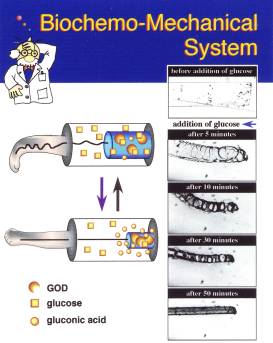 |
| The oxidation of glucose with the immobilized GOD bought about gel collapse (see the right-hand photograph), through which biochemical energy would be converted into a mechanical work (the left-hand picture). |
|
Biomimetic chemistry will provide a good basis not only for development
of new materials, but also for the understanding of biofunctions in living
systems from a different viewpoint other than the usual concepts utilized
in biochemistry and molecular biology. Our resent studies for simulation
of natural biofunctions with macromolecular systems are focusing on the
regulation of hydrophobic interaction and/or hydrogen bonding, both of
which serve as an attractive force in balance with a repulsive force, usually
electrostatic in nature. Moreover, we are also interested in how to apply
knowledge gained from such basic research towards solving problems in the
fields of biomedical devices and environmental pollution control techniques. |
|
| Selected Publications |
1. M. Masakii, E. Kokufuta: Polyampholyte Gels of a Cross-linked Polyanion or Polycation Network
into Which an Oppositely Charged Polyion Was Immobilized: Their pH-Induced Swelling/Shrinking Characteristics, Colloid. Polym. Sci. DOI 10.1007/s00396-012-2771-2 (Published online: 04 September 2012).
2. R. Doi, E. Kokufuta: Conductometric and Light Scattering Studies on the Complexation between
Cationic Polyelectrolyte Nanogel and Anionic Polyion, Langmuir, 27 [1], 392-398 (2011).
3. R. Doi, E. Kokufuta: On the Water Dispersibility of a 1:1 Stoichiometric Complex between
a Cationic Nanogel and Linear Polyanion, Langmuir, 26[16], 13579-13589 (2010).
4. M. Kano, E. Kokufuta: On the Temperature-Responsive Polymers and Gels Based on N-Propylacrylamides and N-Propylmethacrylamides, Langmuir, 25[15], 8649-8655 (2009).
5. M. Furukawa, R. S. Farinato E. Kokufuta: Potentiometric Titration Behavior of Poly(acrylic acid) within a Cross-linked Polymer Network Having Amide Groups, Colloid Polym. Sci., 286[12], 1425-1434 (2008).
6. E. Kokufuta, K. Ogawa, R. Doi, R. Kikuchi, R. S. Farinato: Geometrical Characteristics of Polyelectrolyte Nanogel Particles and Their Polyelectrolyte Complexes Studied by Dynamic and Static Light Scattering, J. Phys. Chem. B, 111[29], 8634-8640 (2007).
7. M. Miyake, K. Ogawa, E. Kokufuta: Light Scattering Study of Polyelectrolyte Complex Formation between Anionic
and Cationic Nanogels in an Aqueous Salt-free System, Langmuir, 22[17], 7335-7341 (2006).
8. E. Kokufuta: Polyelectrolyte Gel Transitions: Experimental Aspects of Charge Inhomogeneity
in the Swelling and Segmental Attractions in the Shrinking, Langmuir (Special Issue in Honor of Robert L. Rowell), 21[22], 10004-10015 (2005).
9. Y. Ogawa, K. Ogawa, E. Kokufuta: Swelling-Shrinking Behavior of a Polyampholyte Gel Composed of Positively
Charged Networks with Immobilized Polyanions, Langmuir, 20[7], 2546-2552
(2004).
10. H. Suzuki, A. Kumagai, K. Ogawa, E. Kokufuta: New Type of Glucose Sensor Based on Enzymatic Conversion of Gel Volume
into Liquid Column Length, Biomacromolecules, 5[2], 486-491 (2004).
11. T. Matsudo, K. Ogawa, E. Kokufuta: Complex Formation of Protein with Different Water-soluble Synthetic Polymers, Biomacromolecules, 4[6], 1794-1799 (2003).
12. K. Yabusaki, E. Kokufuta: Aggregation Mechanism of Blood Platelets by Time-Resolved Light Scattering Method, Langmuir, 18[1], 39-45 (2002).
13. K. S. Schmitz, B. Wang, E. Kokufuta: Mechanism of Microgel Formation via Crosslinking of Polymers in Their
Dilute Solutions: Mathematical Explanation with Computer Simulations, Macromolecules, 34[23], 8370-8377 (2001).
14. E. Kokufuta, B. Wang, R. Yoshida, A. R. Khokhlov, M. Hirata: Volume Phase Transition
of Polyelectrolyte Gels with Different Charge Distributions, Macromolecules, 31[20], 6878-6884 (1998).
15. E. Kokufuta, S. Matsukawa, T. Tanaka: Enzymatically Induced Reversible Gel-Sol Transition
of a Synthetic Polymer System, Macromolecules, 28[9], 3474-3475 (1995).
16. E. Kokufuta, Y.-Q. Zhang, T. Tanaka: Saccharide-sensitive Phase Transition of a Lectin-loaded
Gel, Nature, 351[6324], 302-304 (1991).
17. F. Ilmain, T. Tanaka, E. Kokufuta: Volume Transition in a Gel Driven by Hydrogen Bonding, Nature, 349[6308], 400-401 (1991). |
|